Know when you run out — months before you do.
On megaprojects, 1,000–5,000 temporary workers collide with fixed site services. Parking, welfare, canteens and buses reach capacity and are discovered reactively — as queues, complaints and statutory exposure. No one is commissioned to convert the headcount curve into demand, compliance and cost. Genkai does it.
The report
What lands every month
Capacity stacked against the headcount-driven demand curve. The date each domain runs out — months before it does — and the decide-by date behind it.
S.I. 291/2013 ratios versus actual provision: requirement curve, shortfall at peak, and the date the statutory ratio is reached. UK, German and US tables slot in per jurisdiction.
Monthly logistics spend against headcount with observed elasticities — showing cost per head falling as the site scales, or flagging why it isn't.
Every capacity-reach date carries two to three costed remedies and a named owner. Change anything — re-runs are unlimited inside the fee.
Inside the pack
What the report actually looks like
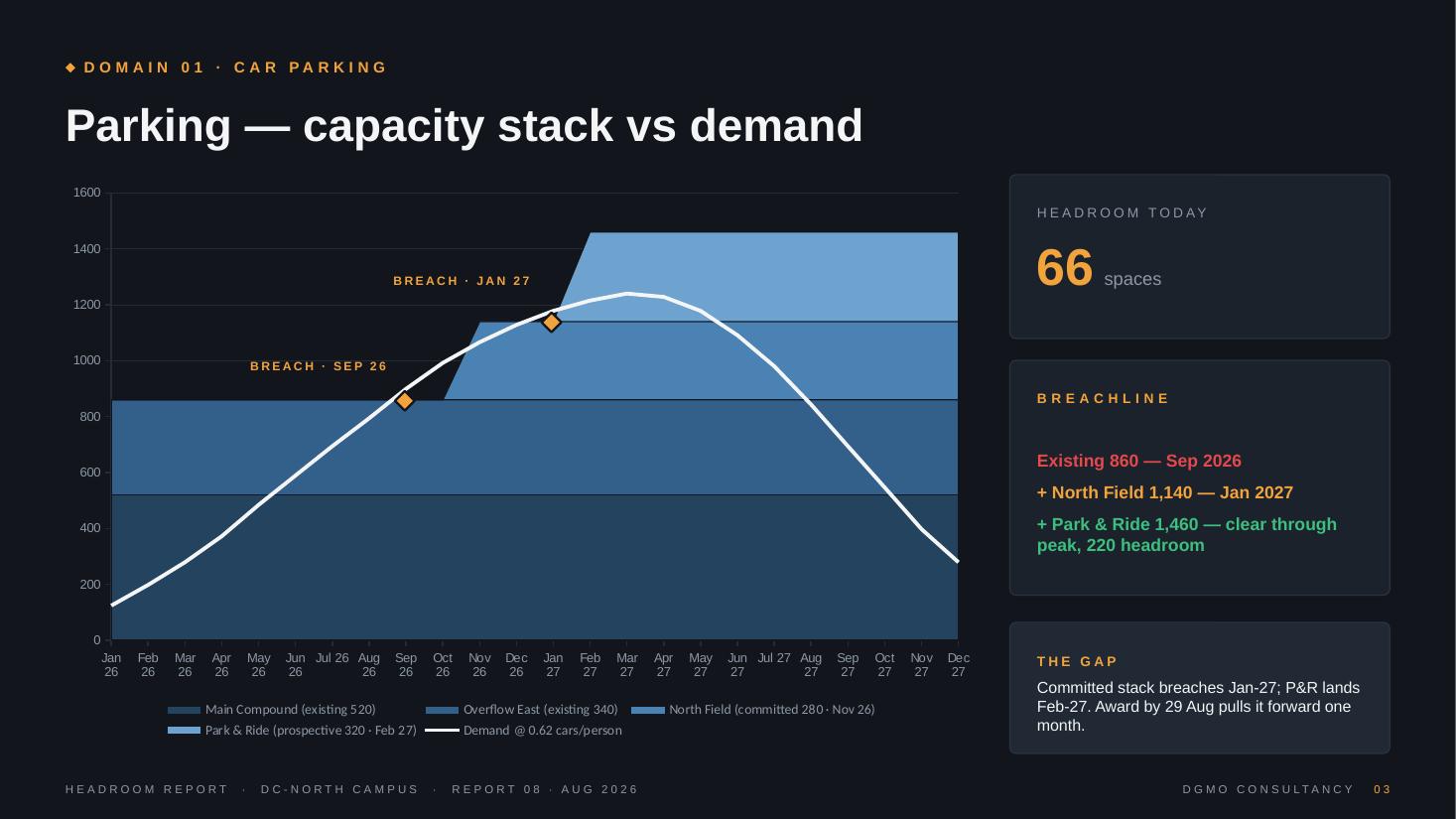
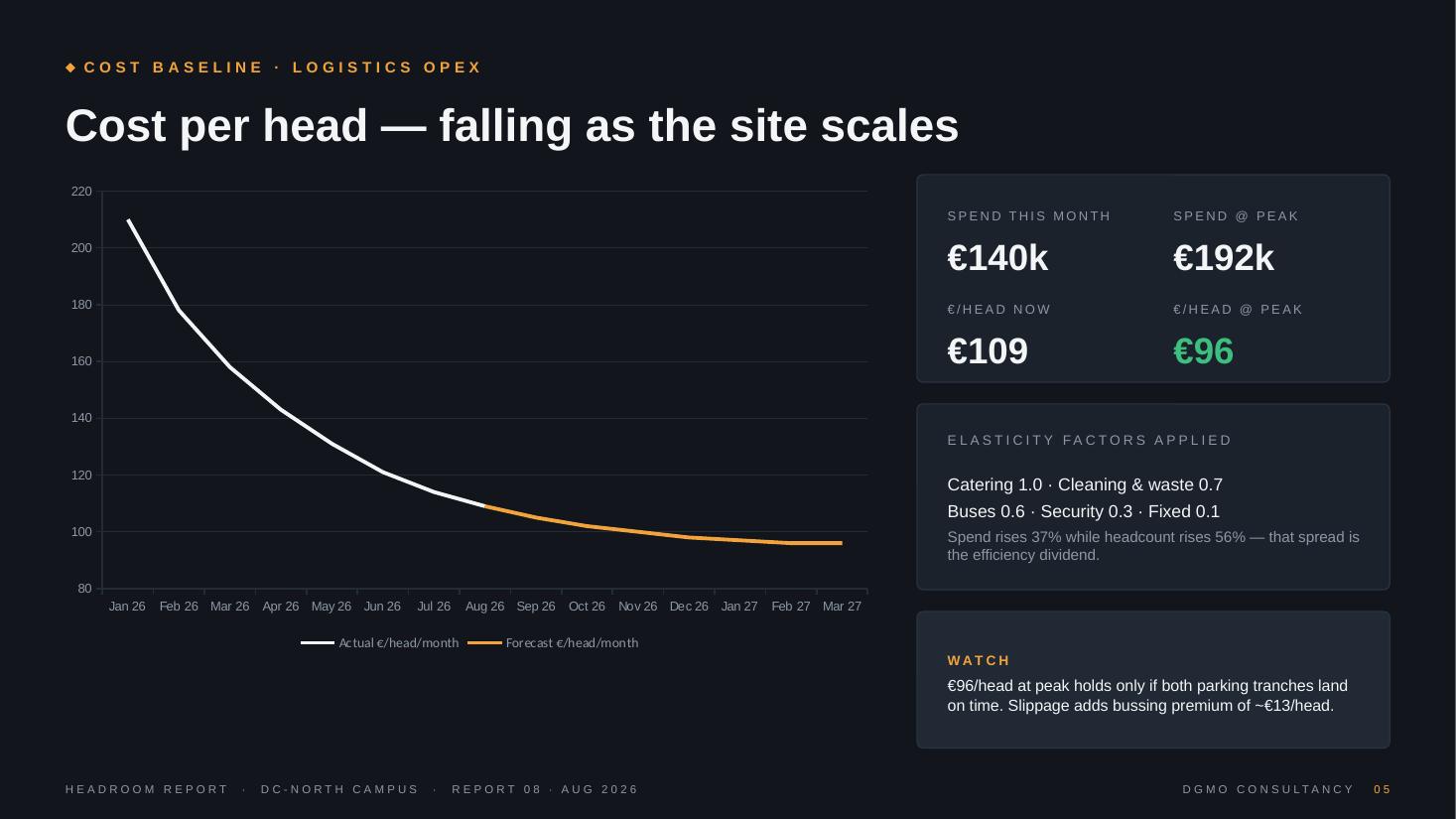
Pages from the demonstration issue — synthetic data. The full pack is available on request.
Live demonstrations
See it moving, not just printed
Fifty-five seconds through a standing pack in its live form — DC-North Campus, a fictional programme on synthetic data throughout. Eight domains driven off one headcount curve, each with its capacity-reach date, its decide-by date, a costed remedy and a named owner — and the difference between a physical cap and a consented one. Captioned throughout; it runs with or without sound.
Beyond the film: the Watch dashboard itself, an interactive parking scenario model and complete sample plans exist as private, access-keyed demonstrations — keys issued personally per prospect, so the walk-through can be shaped around your programme rather than ours. Request access.
Coverage
Eight domains, one statutory lens
Every issue also carries: actuals-vs-forecast reconciliation · winter-readiness status · unlimited scenario re-runs · ingestion of any format — spreadsheets, PDFs, photos.
These eight are a default, not a fixture. They bind on most construction-era programmes, which is why they are watched as standard. Part of the diagnostic is establishing which actually bind on yours — domains swap one-for-one with the wider estate on that evidence, so the pack stays the same size and the same price.
They also take the shape of your asset. On a live airport, gates and induction means the pass office, the vetting queue and airside vehicle permits, and parking means contractor demand competing with revenue parking. On a rural campus it is beds and the road network. On a fab it is temporary power and tool-install movement. Deciding which eight, and what each one means on your site, is the work.
Two kinds of limit are watched. A physical cap is what the asset can hold, and the model gives it a capacity-reach date. A consented cap is what a planning condition, a construction traffic or environmental management plan, or an environmental impact assessment assumption allows, and the model gives it a cap-reach forecast — with the instrument quoted, the clause referenced, and the route to relief named.
The wider estate — temporary power and utilities, foul, water and drainage, traffic management and segregation, craneage and material movement, earthworks and spoil, waste and environmental compliance, emergency access and muster, commissioning-phase logistics — is authored in full in the Execution Plan.
Against your framework
Why your existing advisors don’t already do this
Not because they can’t. Because nobody has been asked to.
A programme manager is commissioned on cost and schedule and reports on both, package by package. Capacity is neither. It is consumption, and it lives in different systems entirely — turnstile logs, car park counts, canteen tills, bus manifests, bed bookings. None of that reaches a cost report or a P6 schedule, and no line in a PM appointment says who owns the sum of it.
The gap is structural on a multi-contractor site. Each contractor plans its logistics inside its own fence, and each plan is reasonable on its own terms. They are all drawing on the same roads, the same car parks, the same induction centre. Nobody is commissioned to add them up — so the first time anyone sees the combined curve is the week it reaches capacity.
That is the whole job, and it sits beside your framework rather than competing with it. Your programme manager keeps cost and schedule. We hold the consumption model and hand you dated decisions with the arithmetic shown.
Method
How it works
Send data in whatever format it lives in — lookaheads, registers, spreadsheets, PDFs, photos.
The engine converts headcount into demand versus capacity, statutory minimums and cost.
The pack lands monthly. Change anything, as often as you like — no per-change fees.
The offer
Three ways in, two ways on
1. The Breach Check — one domain, ten working days
One domain, one dated answer: the week it reaches capacity, the date you have to decide by, and the arithmetic in full so you can challenge it. A headcount curve and one capacity number is enough to run it. Priced per domain, credited in full against a diagnostic — most people start with one.
2. Capacity Diagnostic — fixed scope, six weeks
Full baseline across all eight domains, capacity-reach map, welfare compliance position, costed remedies with named owners.
3. Retrospective — your own record, re-read
For a programme already past its peak, or past its problems. Weekly actuals — gate counts, canteen sittings, parking occupancy, bus loads, vehicle movements — rebuilt into the eight curves. For each domain: the date capacity was actually reached, the decide-by date that implied, and what the gap cost at your own rates. The month-by-month case for watching the next one.
Thereafter: a standing monthly pack — this format every month, actuals reconciled against forecast, unlimited re-runs, per project, cancel any time — and remedy delivery, fixed-scope support to procure and land any fix we flag.
Every engagement is a fixed fee, quoted in writing before any work begins — no day rates, no variations, no scope creep.
Costed with provenance
What a remedy actually costs
taken from the regulation and cited by instrument and clause
measured on your site, or quoted for your engagement — with source and verification date
stated as an assumption, with the confidence we hold it at, until an observation replaces it
Every remedy is costed, and every figure in every issue carries one of these three markers with its source and date. Rates come from your own records or from quotes obtained for your engagement; nothing is carried across from another client's programme. Ratios are inputs, never constants. Challengeable line by line: that is the point.
S.I. 291/2013 (as amended) live today. Great Britain: the CDM 2015 Schedule 2 duty, with the numbers taken from the Workplace (Health, Safety and Welfare) Regulations 1992 ACOP, since Schedule 2 sets no ratios itself. Germany: BaustellV, with ASR A4.1 and A4.2 carrying the tables. US: 29 CFR 1926.51 federally, and the State Plan standard where one applies.
Every contractor's pack aggregated into one campus demand model — the picture no single contractor can see.
Dust PM10, noise dBA and vibration PPV tracked against planning-condition limits, same capacity-reach logic.
Common questions
Before you ask
What does Genkai mean?
限界 — Japanese for the limit: the point past which something can no longer go. Which is the whole job, really. The practice was previously called Headroom.
What data do you need?
A headcount curve and whatever capacity records exist — in any state. Lookaheads, registers, spreadsheets, PDFs, photos of whiteboards. Part of the diagnostic is establishing the baseline where records are thin.
Can I speak to someone who has worked with you?
Yes. References are available on request — including people who have run these systems at megaproject scale and directors on the contracting side. Where anyone offered has a commercial interest in DGMO, we say so before you speak to them.
Is our data safe?
Your data stays yours. Reports are project-confidential, nothing is shared across clients, and we'll sign your NDA before seeing a single number.
Which jurisdictions?
Ireland (S.I. 291/2013, as amended) live today. Great Britain runs on the CDM 2015 Schedule 2 duty with the Workplace Regulations 1992 ACOP table behind it, and Northern Ireland on its own 2016 regulations. Germany: BaustellV with ASR A4.1 and A4.2. United States: 29 CFR 1926.51, or the State Plan standard under the 22 State Plans covering private-sector construction — Arizona and California among them. Same engine, the right table per site.
How fast is the first result?
A provisional capacity-reach map lands within ten working days of your data arriving — every figure flagged at stated confidence — then hardens through verification into the final board-ready pack across the six-week scope.
See it on your numbers
A headcount curve and a capacity register are enough to start. The first capacity-reach date usually surprises.
Terms
Every engagement is a fixed fee, quoted in writing before any work begins. Capacity-reach dates, cap-reach forecasts and decide-by dates are forecasts, issued at a stated confidence, and are not a warranty of outcome. Client data is held in confidence under the client's own NDA and is never reused, quoted or carried across to another engagement. Everything shown publicly on this site, in the film and in the demonstration pack is synthetic. Ratios are inputs carrying a source and a confidence marker, and the client may substitute their own at any time. Nothing here is planning, legal or engineering advice; where a remedy or a consented cap needs consent, that is flagged as "planning advice required". Contracts are governed by the law of Ireland.